An Op-ed I wrote on the issues of bothsidesism.
By Hannah Sammut
Question 2: Look at an issue and examine why it is covered the way it is, through the lens of race
When Bothsidesism Falls Short– How Top Papers Let Racist Implications Slide in an Effort to Remain “Fair” by Hannah Sammut
For as long as the institution of journalism has existed, there was an obligation to report the facts; nothing more, nothing less. Yet in the age where there seems to be a slew of “alternate facts” flooding Twitter timelines and news is accessible instantaneously, newsrooms had to adapt and keep up.
The dissemination of fake news and frequent attacks on the media by President Trump left only 32% of Americans having trust in the media in 2016, according to a Gallup poll.
In an effort to improve these numbers and still hold onto traditional practices, newsrooms tried to take a “both sides” approach– one that only has validity when there are truly two sides to the story. During a presidency that is run on fake news, disillusionment, fear, hate, and most notably, racism, one can guess why bothsidesism would have its shortcomings.
Yet during the peaceful protests that followed Goerge Floyd’s death in May, a time that left so many in the country heartbroken, frustrated, and most importantly, willing to look America’s broken systems in the eye and strive for change, it was news publications that missed the mark.
These publications, who are supposed to represent those from all different backgrounds, chose to partner with the obsolete “both sides” approach. While the initial hurt of Black communities was covered and so were initial protests, the shift to bothsidesism was beginning to manifest itself in national papers.
When storylines of peaceful protests got old, coverage of the radicalized counter-protestors took primetime television spots, including the sensationalization of a St. Louis couple who aimed their firearms at attendees of a Black Lives Matter protest who neared their property line. That same couple were later congratulated for “protecting their second amendment rights” and were told that being prosecuted by a Missouri judge on a misuse of weapons charge was “an egregious use of power”, according to President Trump. Their TV exposure and commendation by the President (even later speaking at the RNC) inspired others to display their semi-automatics at protests, turning the once peaceful movement on its head, and swaying coverage from the Black Lives Matter Movement’s original message.
Others followed in their tracks, and protesters were met with armed militias in Rochester, Boise, and a notable Proud-Boys crowd Kalamazoo, MI. One even turned fatal when a 17 year old shot three protestors in Kenosha, WI, killing two.
Readers were left bewildered; how are “both sides” supposed to be covered during a time with the Black community so obviously hurting?
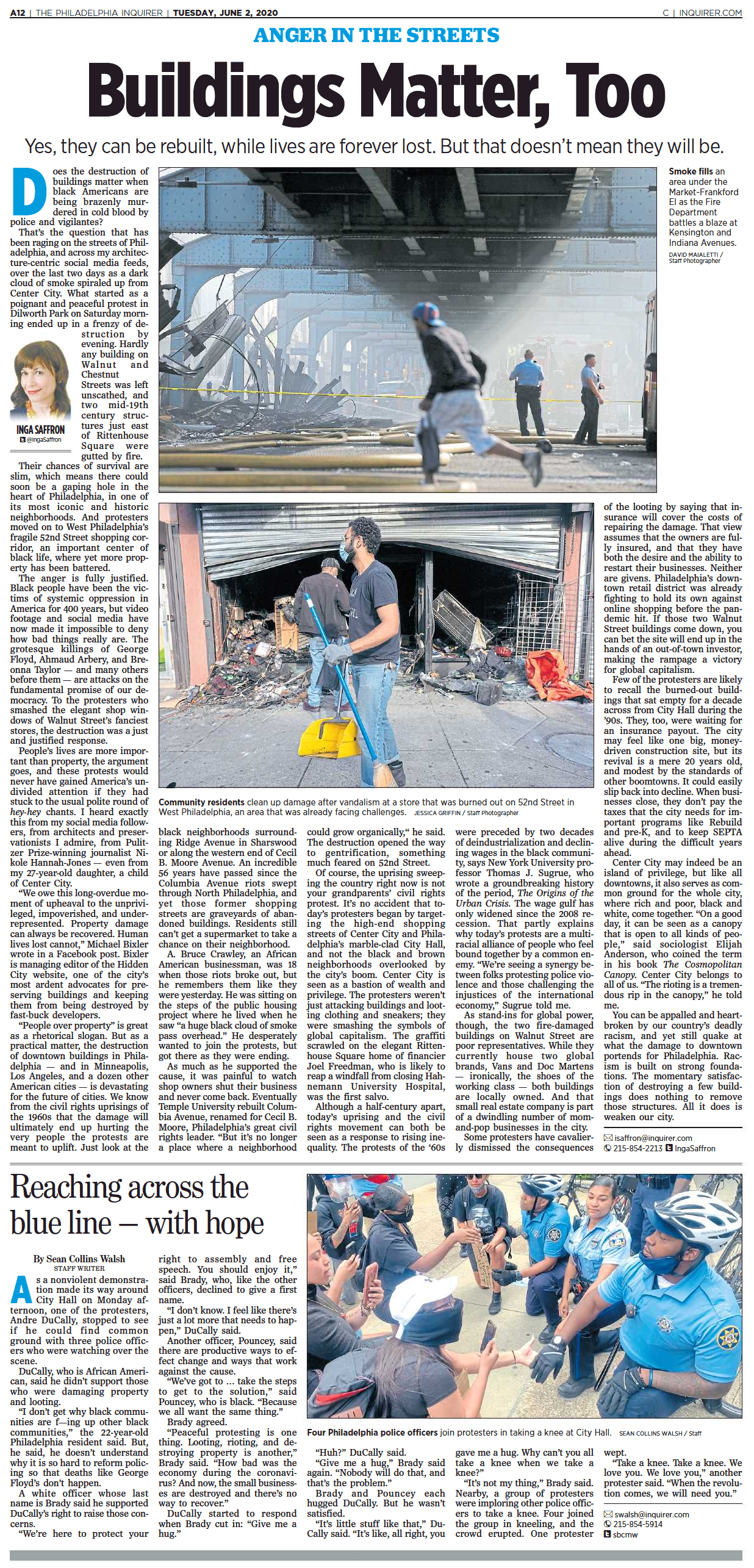
However, it was the inclusion of op-eds that were aimed at trying to level the playing field that caused so much hurt and damage to the Black community. A notable example is one mistakenly run by The Philadelphia Inquirer, titled “Buildings Matter, Too” by Ingra Saffron.
The title is a direct play on the movement Black Lives Matter, suggesting that buildings and Black lives hold similar value.
Saffron makes the argument that it’s ultimately the protestors who will have to pay the price for the long-term structural damage in cities. What’s more, she says, “‘People over property’ is great as a rhetorical slogan. But as a practical matter, the destruction of downtown buildings in Philadelphia…is devastating for the future of cities.”
So much criticism and backlash occurred after the article was published that the title of the online version was changed, an editor’s note apologizing for publishing the Saffron’s piece was issued, and the Inquirer’s executive editor resigned.
44 Journalists of Color at the Philadelphia Inquirer signed a petition in response to the article, demanding action and fair reporting of marginalized communities. For them, they saw how the Inquirer continuously had fallen short at engaging with Philadelphia’s majority of color city. Most importantly, they wrote they were “tired of being told to show both sides of issues there are no two sides of.” For them, the Inquirer’s subsequent embarrassment “is not worth our humanity.”
The suggestion that infrastructure is more important than the lives of those who were taken needlessly from our broken police system is an abhorrent one. It’s a glaring example of what can happen if publications decide to cover a story where there isn’t a credible “other” side.
The “other” side is one that serves as a call to action to other militants, to take to the streets and quell a movement that so many Black Americans yearn to achieve. The “other side” is one that says Black lives don’t matter, or that Black lives could somehow ever be quantified, like property. Oh wait, they have.

 Hannah Sammut